



Containerizing the Global South: Universalism, Relativism, and the Silenced Other
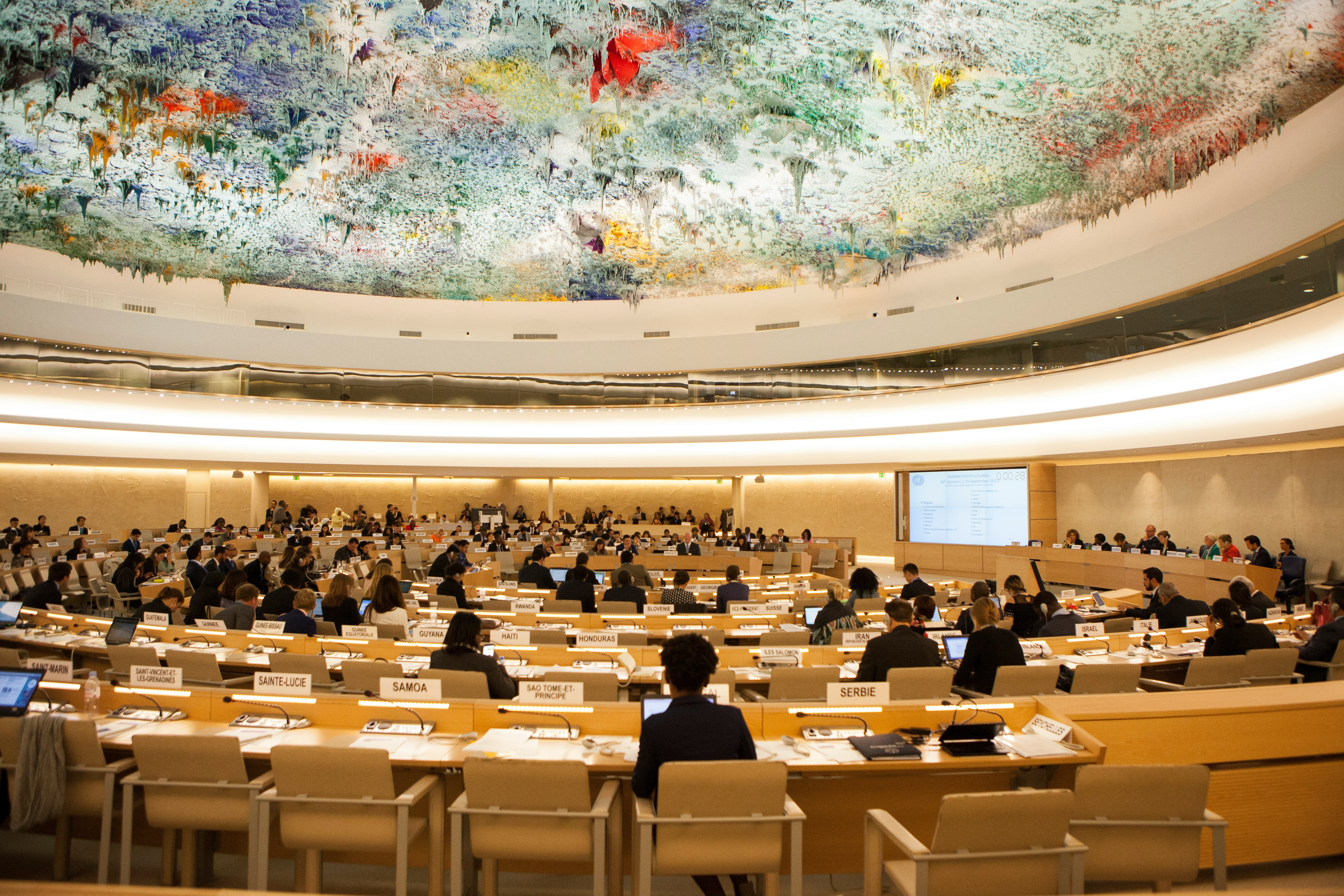
A rethinking of human rights beyond Eurocentric frames
The so-called universality of rights has often hidden an underlying moral geography, a worldview accepted as too obvious to question. Time and again, this idea has been polished and repeated in conference halls and academic papers, celebrating certain narratives while ignoring others. Yet, beneath the impressive chorus of universalism, the Global South has long awaited recognition, constantly caught between silence and the slow, cautious grammar of inclusion.[1]
The socio-legal scholar Kathleen Cavanaugh[2] (in citing Marvin), questions whether there exist truly universal moral principles and rules of right conduct, or whether universalism is a little more than a guise for ethnocentrism and cultural imperialism. Years of such debates have shown that it is not the universality of rights that fails, but the unequal moral ground upon which they stand. The dream of universality has been noble; a vision of nations bound by shared dignity and justice, yet often stumbling against the walls of power and history. This truth was rightly captured by Martin Luther King Jr., when he declared that people of the South must refuse to believe in the bankruptcy of the bank of justice.[3] In evoking the “bank of justice,” King reminded the world that justice was/is not exhausted but simply unevenly distributed and withheld from those whose humanity was deemed negotiable. Decades later, across Africa and the Middle East, states have long relied on that hope, awaiting a justice system that speaks their language. Yet the structures through which justice is delivered often distort its essence, promising equality while perpetuating hierarchies.
Drawing from Prof. Makau Mutua’s critique, the universalism of law has unfolded as a web of contradictions[4] far from the pure moral force its defenders have proclaimed. Yet even within its earliest formations, a quieter logic of control was already present, the very condition Mahmood Mamdani would later describe as the containerization[5] of subject peoples: a state in which the Global South was acknowledged, yet confined within moral and political boundaries defined elsewhere. It's in this inherited logic of containment that endured beyond colonial borders, quietly shaping the global rights discourse, where recognition of difference often masked the preservation of dominance. It’s within this discourse that the infamous repugnancy clauses carefully laid the groundwork for what would become “supremacist laws.” Professor Ambani reflects that when the British entrenched their rule in Africa, they selectively recognized certain aspects of African customary law and religion, yet subjected them to the notorious “repugnancy clauses”[6] that became legal sieves designed to filter out customs deemed inconsistent with European morality. Mamdani further argued that this use of the repugnancy clause was “a concession more to power than to polite society”. He adds that this selective recognition was a mechanism of acknowledging that Africans as subjects were confined and defined by the colonial imagination.
This colonial anxiety over difference was well illustrated in the Amkeyo case,[7] where a British court rejected the African tradition of dowry payment as a mere act of sale, ruling that a woman could not be considered a wife by virtue of such payment; a sly subversion of African marital norms and a bypass of the law that forbade a wife from testifying against her husband. Ocran[8] also observes that this selective acceptance reflected a deeper clash between African and European legal cultures, a struggle over whose values would be deemed “civilized” and whose would be readily dismissed. This litmus test of morality and justice was, from inception, a rigged tribunal - where one side defined reason, and the other merely stood trial.
Relativist theorists, by contrast, insist that human rights should differ by states, shaped by the values, cultural practices, and religious traditions of a people.[9] The doctrine of universalism was formally endorsed at the World Conference on Human Rights, which sought to bind the international community to a shared moral language of dignity, freedom, and justice, as enshrined in the Universal Declaration of Human Rights (UDHR).[10] Yet between these two poles of universalism and relativism, lies a quiet struggle for moral authority: whose values, whose humanity, and whose voice define the “human” in human rights?
Prof. Mutua’s reflection on the human rights narrative cautions that the campaign to universalize human rights bears an “incurable virus”, the relentless urge to universalize Eurocentric norms by “repudiating,” “demonizing,” and “Othering” what is different and non-European. This tension between principle and power is central to the politics of universalism, revealing how moral claims often collide with strategic interests. History offers vivid illustrations: in Dag Hammarskjöld’s (the UN Secretary-General, 1953-1961) refusal to let Congo become another pawn of the Cold War, we see a universalism of conscience, one that resisted the seductions of national interest. So too, in Nelson Mandela’s insistence on reconciliation over revenge, we find a reminder that moral courage, not might, remains the truest test of universality.
The moral hierarchies often exported under the banner of universalism reflect what the 19th-century English philosopher Jeremy Bentham might have called imported moral preaching, lofty ideals untethered from the lived realities of those they claim to emancipate:
“What is the source of this premature anxiety to establish fundamental laws? It is the old conceit of being wiser than all posterity, wiser than those who will have had more experience… enabling the dead to chain down the living.”[11]
This early suspicion of moral absolutism resurfaces centuries later within the United Nations. In the Human Rights Council’s Universal Periodic Review, Roger Blackburn[12] highlights that many states, particularly from the Global South, have always expressed unease. They argue that while universalism rests on the indivisibility of human rights, it often operates as a projection of Western values. Prof. Rebecca Wallace similarly notes that rights are not abstract universals; she criticizes international human rights instruments for reinforcing Western concepts and values in the guise of universal ones.[13] Culturally plural nations contend that rights derive meaning from context, that they are lived through culture, not imposed upon it. Muammar Gaddafi, in his Green Book, echoed this relativist sentiment. He rejected the Western liberal framework that defines freedom as atomized individuality. To Gaddafi, true rights were embedded in one’s organic relationship to tribe, religion, and community.[14] He believed the so-called “universal” system merely replaced colonial rule with moral imperialism, dressing domination in the language of humanitarianism. His Libya, for all its flaws, became an attempt to root governance in indigenous moral logic rather than borrowed liberal forms.
Building on this tension, Prof. Mutua contends that the West safely crafted itself as saviour, cast the non-Western world as savage, and positioned the suffering subject as a victim caught between them. This “Savage–Victim–Saviour” metaphor became the architecture of international morality; Europe as rescuer, Africa as the rescued savage, and culture as casualty.[15]
Recently, at the 80th Session of the United Nations General Assembly, leaders from the Global South renewed their historic call for equality within the UN system, demanding a redistribution of power long monopolized by the five permanent members of the Security Council. It is here that the contradiction at the heart of universalism revealed itself. The world’s perpetual “Others” remain present in name, peripheral in power, and bound by a performance of inclusion that never truly includes. In an article by the Pambazuka editors, the politics of naming often extends into the politics of not naming when it becomes convenient - a dynamic made visible in the UN’s reluctance to call the atrocities in Palestine by their rightful name, an act of political avoidance and complicity.[16] It’s in this silence that the hierarchy of humanity reveals itself: who may speak, and who must be spoken for. Such is the truest face of global inequality, where muteness meets the world’s moral deafness; where silence and exclusion have become a theatrical performance of “othering.” The Global Southerner and his rights remain linguistically displaced, always the uninvited guest at the dinner table, awaiting permission to feel human again.
Perhaps then, universalism must finally be reborn as pluralism, in both dialogue and action. Only then will the Global South cease to be spoken for and begin to speak as an equal author of the human story. The task before this generation is to reject modern containerization, to decolonize the grammar of exclusion, and to rewrite the narrative so that the Global Southerner is no longer the victim, the savage, or the child held hostage in perpetual growth, forever awaiting rescue.
Carolyn W. Gatonye is a tech professional, independent researcher, and law student at Kabarak University, Kenya. Her work explores the intersections of law, history, literature, and governance, with a particular focus on youth marginalization, protest cultures, and human rights.
Endnotes
[1] Mutua, M. (2001). Savages, Victims, and Saviors: The Metaphor of Human Rights. Harvard International Law Journal, Vol. 42, No. 1, pp. 201–245. https://papers.ssrn.com/sol3/papers.cfm?abstract_id=1525547
[2] Kathleen Cavanaugh, Uncommon Ground: Culture and Othering In The Human Rights Project. https://www.swlaw.edu/sites/default/files/2023-07/5%20-%20Cavanaugh.pdf
[3]Martin Luther King Jr., I Have a Dream Speech. https://www1.udel.edu/htr/American/Texts/king.html
[4] Mutua, M. (2001). Savages, Victims, and Saviors: The Metaphor of Human Rights. Harvard International Law Journal, Vol. 42, No. 1, pp. 201–245.
https://papers.ssrn.com/sol3/papers.cfm?abstract_id=1525547
[5] Mamdani, M. (1996). Citizens and Subjects, p. 51. Mamdani describes how the colonial state “containerized” the African subject, “encased by custom, frozen into so many tribes, each under the fist of its own Native Authority” - a technique of control learned from Britain’s Indian empire and France’s Indochinese experience.
[6] Ambani, J. O., & Ohaya, O. (2015). The Wretched African Traditionalists in Kenya: The Challenges and Prospects of Customary Law in the New Constitutional Era. https://papers.ssrn.com/sol3/papers.cfm?abstract_id=3623205. The repugnancy clauses were meant to rule out laws and customs perceived to be against Christian values and morality or cruel and unusual standards of the colonizers. There were various formulations of these clauses. Some stated that the rules should not be repugnant to “natural justice, equity and good conscience.” Others read: “Not contrary to [religious] justice, morality or order.” Still others read: “Not repugnant to morality, humanity or natural justice or injurious to the welfare of the natives.”
[7] Rex v Amkeyo (1917) 7 EALR 14. In the famous case of Amkeyo, the Chief Justice Hamilton, would note in his ruling on dowry payment: “… the use of the word ‘marriage’ to describe the relationship entered into by an African native with a woman of his tribe according to tribal custom is a misnomer which has led in the past to considerable confusion of ideas. I know of no word that correctly describes it; ‘wife-purchase’ is not altogether satisfactory, but it comes much nearer to the idea than that of ‘marriage’ as generally understood among civilised people.”. The alleged custom of dowry payment was implicitly repugnant to conscience and morality.
[8]Ocran, as cited in Ambani & Ohaya, 2015. https://papers.ssrn.com/sol3/papers.cfm?abstract_id=3623205
[9] Rebecca M.M. Wallace, International Law: Human Rights, Sweet & Maxwell Ltd., p. 226.
[10] World Conference on Human Rights, Vienna Declaration (1993), para. 5.
[11]Bentham, J. (1843). Anarchical Fallacies. https://tinyurl.com/Anarchical-Falacies
[12] Blackburn, Lloret. (2012). Cultural Relativism within the UN Human Rights Council’s Universal Periodic Review. https://papers.ssrn.com/sol3/papers.cfm?abstract_id=2033134
[13] Rebecca M.M. Wallace, International Law: Human Rights, Sweet & Maxwell Ltd., p. 226.
[14] Gaddafi, M. (1975). The Green Book. Tripoli: The World Center for the Study and Research of the Green Book., Chapter 7, The Law of Society
[15] Mutua, M. (2001). Savages, Victims, and Saviors: The Metaphor of Human Rights. Harvard International Law Journal, Vol. 42, No. 1, pp. 201–245. https://papers.ssrn.com/sol3/papers.cfm?abstract_id=1525547
[16] Pambazuka Editors (2025, October 2). Reflections on the UN General Assembly: Better Together – 80 Years and More for Peace, Development and Human Rights.https://www.pambazuka.org/index.php/UN-General-Assembly