



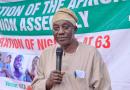
Ozoemena draws from his over two decades acquaintance with and pays tribute to the late Professor Okello Oculi, who passed on July 26, 2025, in Abuja, Nigeria.

Celebrating a Pan African Scientist

The idea of Europeans establishing in Benin City a permanent display of looted Benin artefacts that continue to be in European ownership should be considered by every African as an insult to Nigerians and African peoples. Successors to looters become arbiters of the location and display of Benin artefacts. The wishes of the Oba of Benin are simply ignored. The Benin artefacts should be returned to the Oba of Benin and his people who may decide to organize a display showing artefacts that were looted in 1897 by a violent British army.

Historically, the state is a transient phenomenon. Where are the world’s once great empires? Europe, with just a third of Africa’s population, has produced 23 new states since the late 1980s. There is no point in insisting that the Igbo people, victims of Africa’s worst – and ongoing – genocide, who want their own state, must remain a part of Nigeria.

The attempts to President Buhari’s nominee for anti-corruption chief, Ibrahim Magu has nothing to do with Magu being unsuitable for job. This is a grand scheme of a formidable network of highly placed crooks inside and outside government who are hell-bent on stopping Magu, given the rare vigour and impetus he has introduced to the anti-corruption crusade. Buhari should resubmit Magu’s name to the Senate for confirmation.

The Nigerian labour movement is fragmented and ideologically incoherent. Most people suffer poverty under capitalism, but socialism does not appear as an immediate realistic alternative. As a result, especially in the southern half of the country, churches, both traditional and revivalist, have a huge following, providing hope for many in the next life, if not in this.

Someone asked whether the younger generations ever read Frantz Fanon. But how can they read Fanon when the education system recommends books that teach children that heads are for carrying loads? The older generations should be grateful then that the youth have not read Fanon, Nkrumah or Cabral, because if they had, they would be out on the streets attempting to tear down the system.

The wild celebrations in honour of top-level thief James Ibori's release from prison, though detestable, are quite understandable. Nigerians seem not to be in agreement on what constitutes corruption or who a corrupt person is. What one Nigerian sees as corruption, another sees as a "blessing from God".

The golden era of Nigeria’s civil society featured names such as Wole Soyinka, Alao Aka-Bashorun, Gani Fawehinmi, Beko Ransome-Kuti, Olisa Agbakoba, Femi Falana, Baba Omojola, Comrade Ola Oni, Ayo Obe, Dr. Segun Osoba, Idowu Awopetu, Clement Nwankwo, Frank Kokori, Chidi Odinkalu, Abdul Oroh, Richard Akinnola…But today things are sadly different.

If there was one thing Nigeria needed so much at independence, it was a selfless, visionary, and nationalistic leadership that would have helped forge a nation out of the unworkable contraption left behind the British. The crisis of nationhood now lasting more than half a century can only be resolved through genuine devolution of power, so that Nigerians wherever they are will take their destiny in their own hands.

Freedom of expression and the press is guaranteed under Section 39 of Nigeria's Constitution. But restrictive laws which allow for journalists and bloggers to be arrested for reporting critically on politicians and others, violates that right.

In May, Nigeria played a key role to block African Union membership for Haiti. What a shame! The first African republic established by slaves in 1804, Haiti is 95 per cent Black. With its illustrious history, Haiti will surely play a more prominent role in a future African world organisation of peoples and states – not the currently constricted and contrived AU.

Nigeria’s ruling elites are blithely pursuing a neoliberal path of self-destruction, setting the stage for a national meltdown unless diverted by some miracle. Unaddressed grievances have spawned numerous violent movements actively championing secession of their regions from the federation. The nation-building project has failed. And as no sensible alternative is being offered, the result in the long-run could be utter chaos.

Since assuming office on May 29, 2015, President Buhari has lived up to his campaign promise of tackling corruption headlong and providing a fresh template for instilling transparency and accountability. Nigeria could be a model for fighting this monster that gobbles up some $2.6 trillion annually from the global economy.

Nigeria is gripped by the familiar anxieties of an economy in distress. This escalating crisis has demystified a president once thought capable of astute, if not magical, economic management. In their desperation for respite, many Nigerians are now paradoxically yearning for the corruption that they and their leaders blame for their economic woes.

President Buhari comes across as being credible, with an admirably high level of personal integrity. But given the complex nation he heads and its challenges, his virtues and style should be enriched with a healthy dose of balancing, fairness, compassion and a common touch. Only that way will Nigerians enjoy the benefits of the much-touted change.

Nigeria’s problem, which has led to the current calls for restructuring of the country, is failure by the ruling classes to meet the basic needs of their people. There is no evidence that restructuring, whatever it means, would solve this basic problem. Official corruption, mass unemployment, ethno-religious conflicts, an economy that over-relies on oil, are Nigerian realities that cannot be addressed by restructuring.

Talk of breaking up Nigeria is lazy. The country should restructure in a way that every part will, at all times, be appropriately represented in government. This was the central idea in the late General Sani Abacha’s well-thought-out provisions that would have restructured Nigeria from a country of contending ethnic nationalities into a modern nation-state in just 30 years.

What sort of intellectuals would write a book about a genocidal war in which more than three million lives of their own brothers and sisters were wasted without even acknowledging in the index that the word ‘genocidal’ was used in the text by some authors to objectively describe the atrocities?

There seems to be consensus that Nigeria is not working for Nigerians. This is not because Nigeria is unworkable, but because it has been rigged to fail. Forty-six years after the atrocious Biafra War, low-intensity conflicts by state and non-state actors are raging across the country. Nigeria needs to be renegotiated.